

Achieve Superior Transfection: A Guide to Mirus Bio Reagents
Reliable, reproducible DNA, RNA and siRNA delivery across a huge range of cell types, without the toxicity trade-offs of older chemistries.
In this guide, you’ll learn:
- What transfection is and how chemical delivery differs from physical methods like electroporation.
- The four variables worth optimising before you judge a reagent’s performance.
- Which Mirus Bio reagent suits your nucleic acid, cell type, and application, from routine plasmid work to CRISPR and hard-to-transfect primary cells.
Understanding Transfection
Transfection is the process of introducing nucleic acids, such as DNA, mRNA, or siRNA, into mammalian cells by non-viral means. It’s the workhorse technique behind studying gene function, protein expression, and countless other cellular mechanisms. The aim is always the same: get your genetic payload into the cytoplasm or nucleus intact, so the cell’s own machinery can transcribe and translate it.
Broadly, there are two routes in:
Physical methods
Techniques that use physical force to open temporary pores in the cell membrane. Electroporation, where an electrical pulse briefly permeabilises the membrane, is the most common example.
Chemical methods
Carrier molecules complex with the nucleic acid, typically forming a positively charged particle that binds the negatively charged cell membrane and is taken up into the cell. This is where Mirus Bio’s reagents operate.

The Mirus Bio Advantage
What sets Mirus reagents apart isn’t one clever trick, it’s consistent performance across a genuinely wide range of cell types and payloads, held up by three things:
Superior efficiency
Engineered to achieve high expression across a broad spectrum of cell types, including notoriously difficult ones like primary cells and stem cells, so your data comes from a genuinely representative population of transfected cells.
Low cellular toxicity
High viability matters for physiologically relevant results. These formulations are gentle on cells, keeping density stable and avoiding the biases that toxicity-driven cellular stress can introduce.
Simple, versatile protocols
Many reagents are serum-compatible, so there’s no need for a media change. Whatever you’re delivering, DNA, mRNA, or siRNA, there’s a straightforward protocol to match.
How to Optimise Your Transfection
Even the best reagent needs tuning to your particular cell line and payload. Four variables are worth testing before you draw conclusions on performance:
- Reagent-to-nucleic-acid ratio. The single most important variable. Hold the nucleic acid amount constant and titrate the reagent to find your optimum.
- Complex formation time. The incubation period during which reagent and nucleic acid form complexes can shift efficiency. Test the range the protocol suggests.
- Cell density at transfection. Health and division rate matter. Try a spread of confluencies, say 50 to 90%, to see what your cell line responds to best.
- Post-transfection incubation time. The peak of expression or knockdown varies by construct and cell type. Harvest at a few time points, for example 24, 48, and 72 hours, to catch it.
A Reagent for Every Application
Rather than one universal reagent, Mirus offers a tiered range matched to your nucleic acid, your cell type, and how demanding your downstream application is.
High-performance DNA and gene editing delivery
From routine plasmid work through to CRISPR and large-scale production, there’s a reagent built for the job.
TransIT-X2® Dynamic Delivery System
Built for complex DNA delivery: large plasmids, multiple plasmids together, or CRISPR/gRNA. This non-liposomal polymeric system delivers high efficiency with minimal toxicity, making it a solid choice for gene editing, large-scale protein production, and virus generation.
A strong option for hard-to-transfect cell lines, with reliable performance in common lines like HEK 293 and CHO-K1. The animal-origin-free formulation keeps it compatible with the widest range of downstream applications.
The gentlest of the three, balancing high expression with low cell death. A dependable workhorse for routine transfections.
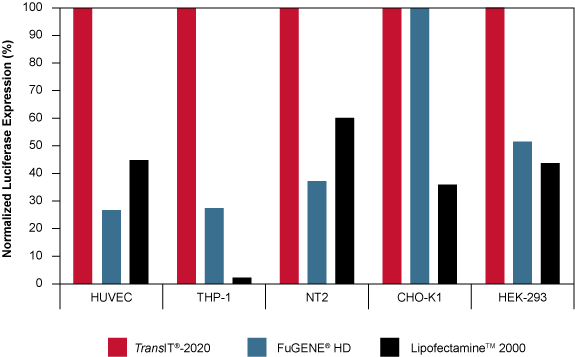
Figure 1. TransIT-2020 gene expression across multiple cell types, benchmarked against two leading competitor reagents.
siRNA, miRNA and large RNA delivery
TransIT-TKO® & TransIT-siQUEST®
Two distinct formulations for gene silencing with siRNA and miRNA. Both offer broad-spectrum delivery and low toxicity, so you can trial both and identify whichever gives the strongest knockdown in your cell line.
TransIT-mRNA® Transfection Kit
Purpose-built for large RNA molecules such as mRNA and viral RNA. In a Huh7/YFV-luc replicon study it outperformed electroporation by 10x while using 2.5x less RNA.
Hard-to-transfect cells and electroporation
Ingenio® Electroporation Solution
For cells that resist chemical transfection altogether, Ingenio® is a cost-effective alternative, compatible with common instruments including the Bio-Rad Gene Pulser® and Amaxa Nucleofector®. It delivers high-efficiency electroporation with better cell viability than many off-the-shelf kits.
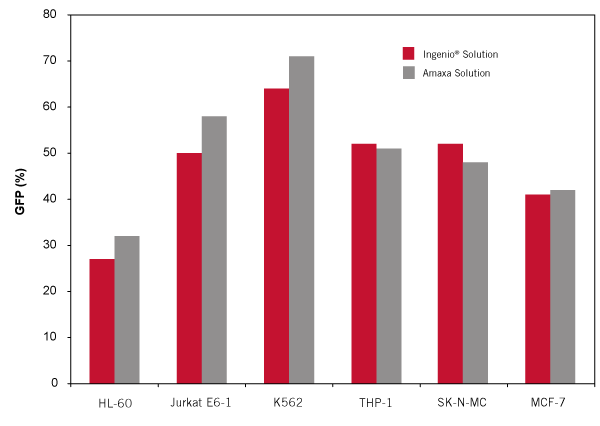
Figure 2. Ingenio® Solution matches or exceeds electroporation efficiency across multiple cell lines and instruments.
Cell-line specific reagents
For cell types with genuinely idiosyncratic membranes or growth requirements, Mirus offers reagents fine-tuned to that specific biology, where a universal reagent tends to underperform:
Complete Your Workflow
A successful transfection is only the start. Confirm and build on it with the right downstream tools.
Confirm Expression by qPCR
Check transfection efficiency at the transcript level with a sensitive, uninhibited dye-based master mix.
Purify RNA Post-Transfection
Recover clean, unbiased total RNA, including small RNAs, from your transfected cells for downstream analysis.
Bank Your Transfected Cells
Preserve successfully transfected clones at -80°C, no liquid nitrogen required, with excellent post-thaw recovery.
Ready to Elevate Your Research?
Stop compromising between efficiency and cell health. Find the Mirus Bio reagent built for your application and start generating data you can rely on.