

Midori Green DNA Stains: A Safer Alternative to Ethidium Bromide
Midori Green is a non-mutagenic DNA stain for agarose gel electrophoresis. It gives band intensity comparable to Ethidium Bromide (EtBr) on a standard UV transilluminator, and it does not need the hazardous waste route that EtBr requires.
Geneflow supplies three formulations: Advance, Xtra and Direct. Each one suits a different set of equipment and workflow, so the section below will help you to choose.
Choosing a Midori Green Formulation
Different experiments place different demands on a stain. Use this guide to match the formulation to your application and to the gel documentation hardware you already have.
Midori Green Advance
Best for: Labs that want to improve safety now using an existing UV transilluminator.
A direct, safer replacement for Ethidium Bromide that needs no change in hardware. It is a sensible first step away from hazardous materials for routine checks, PCR product verification and teaching labs.
Midori Green Xtra
Best for: Labs with a Blue/Green LED transilluminator that need the cleanest background and accurate sizing.
Gives a clear background and sharp bands, and does not cause the electrophoretic mobility shift seen with some other stains, so sizing against a DNA ladder stays reliable. Well suited to genotyping, RFLP and low-concentration DNA libraries.
Midori Green Direct
Best for: High-throughput screening and any protocol that involves gel extraction.
Added to the sample instead of the gel, which shortens the workflow and leaves a very low gel background. Pair it with a Gel/PCR Extraction Kit for cloning, site-directed mutagenesis and NGS sample preparation.
Prefer ready-made gels? Midori Green is also available pre-incorporated into agarose tablets:
Safety
Ethidium Bromide has been the default DNA stain in molecular biology labs for decades because it works well and is inexpensive. It is also a mutagen that intercalates into DNA, so gels and consumables that have touched it are normally handled as hazardous waste under institutional COSHH procedures. For a teaching lab or a core facility running a large number of gels, that adds both cost and administration.
Midori Green was developed to remove that burden. Its safety profile is supported by an independent five-test panel, and the full report is available for you to review.
Five-Test Safety Panel
Midori Green is classified as non-hazardous waste. Disposal should still follow your own institution’s COSHH assessment and local waste policy. Read the full third-party safety report (PDF).
In day-to-day use
- There is no need for a dedicated EtBr waste stream, EtBr-only bins or a decontamination protocol for gels stained with Midori Green.
- It simplifies the risk assessment when new starters or student cohorts join the lab.
- Teaching labs do not need the additional supervision that EtBr handling usually calls for.
Performance
A safer stain is only worth adopting if it does not cost you sensitivity or resolution. Midori Green was compared directly against Ethidium Bromide, SYBR Safe and GelRed under matched conditions.
Midori Green Advance vs Ethidium Bromide (UV illumination)


Result: Band intensity was comparable to Ethidium Bromide on a standard UV table, so Midori Green Advance is a safer, drop-in replacement for labs that do not wish to change their illumination equipment.
Midori Green Xtra vs SYBR Safe (UV illumination)


Result: Under UV, Midori Green Xtra gave a better signal-to-noise ratio, with clearer bands against a darker background.
Midori Green Xtra vs GelRed (Blue/Green LED)


Result: On a safe Blue/Green LED transilluminator, such as the one built into the FastGene® FAS-X gel documentation system, Midori Green Xtra showed a clearer background than GelRed.
In these comparisons Midori Green Xtra also did not cause the electrophoretic mobility shift seen with some other stains, so fragment sizing against a DNA ladder remains accurate.
How the Stains Compare
| Stain | Mutagenicity | Waste classification | Sensitivity | Best illumination | Mobility shift |
|---|---|---|---|---|---|
| Ethidium Bromide | Confirmed mutagen | Hazardous | Good | UV (302nm) | None |
| SYBR Safe | Non-mutagenic | Non-hazardous | Moderate | Blue LED or UV | None |
| GelRed | Non-mutagenic | Non-hazardous | Good | Blue/Green LED | Can occur |
| Midori Green Advance | Non-mutagenic (Ames-negative) | Non-hazardous | Good, comparable to EtBr on UV | UV or Blue/Green LED | None |
| Midori Green Xtra | Non-mutagenic (Ames-negative) | Non-hazardous | Highest signal-to-noise in Geneflow comparisons | Blue/Green LED (also works on UV) | None |
| Midori Green Direct | Non-mutagenic (Ames-negative) | Non-hazardous | High, with very low gel background | Blue/Green LED (also works on UV) | None |
Sensitivity and mobility-shift ratings are based on Geneflow’s internal side-by-side gel comparisons. The images are in the performance section and the mutagenicity and waste data are in the safety section.
Better Downstream Results
The main benefit of a UV-free workflow cannot be seen on the gel image. Standard UV transilluminators expose DNA to light at 254-310nm, which causes pyrimidine dimers and single-strand nicks. This damage does not change how a band looks, but it reduces the efficiency of restriction digests, ligation, transformation and sequencing.
Because Midori Green performs well under safe Blue/Green LED light, UV can be removed from the workflow entirely, protecting the DNA at the point where most protocols damage it.
Cloning efficiency
The comparison below used the same cloning protocol with Midori Green under Blue/Green LED light and with Ethidium Bromide under UV. Removing UV exposure at the gel extraction step more than doubled the number of transformant colonies.


Where this matters most
- Gel extraction before cloning, for example with the FastGene® Gel/PCR Extraction Kit
- Plasmid work after ligation and transformation, for example with the FastGene® Plasmid Mini Prep Kit
- Site-directed mutagenesis and NGS library preparation, where every intact base pair counts
- Precise band excision with the FastGene® Agarose Gel Band Cutter, which leaves less surrounding gel
Cost
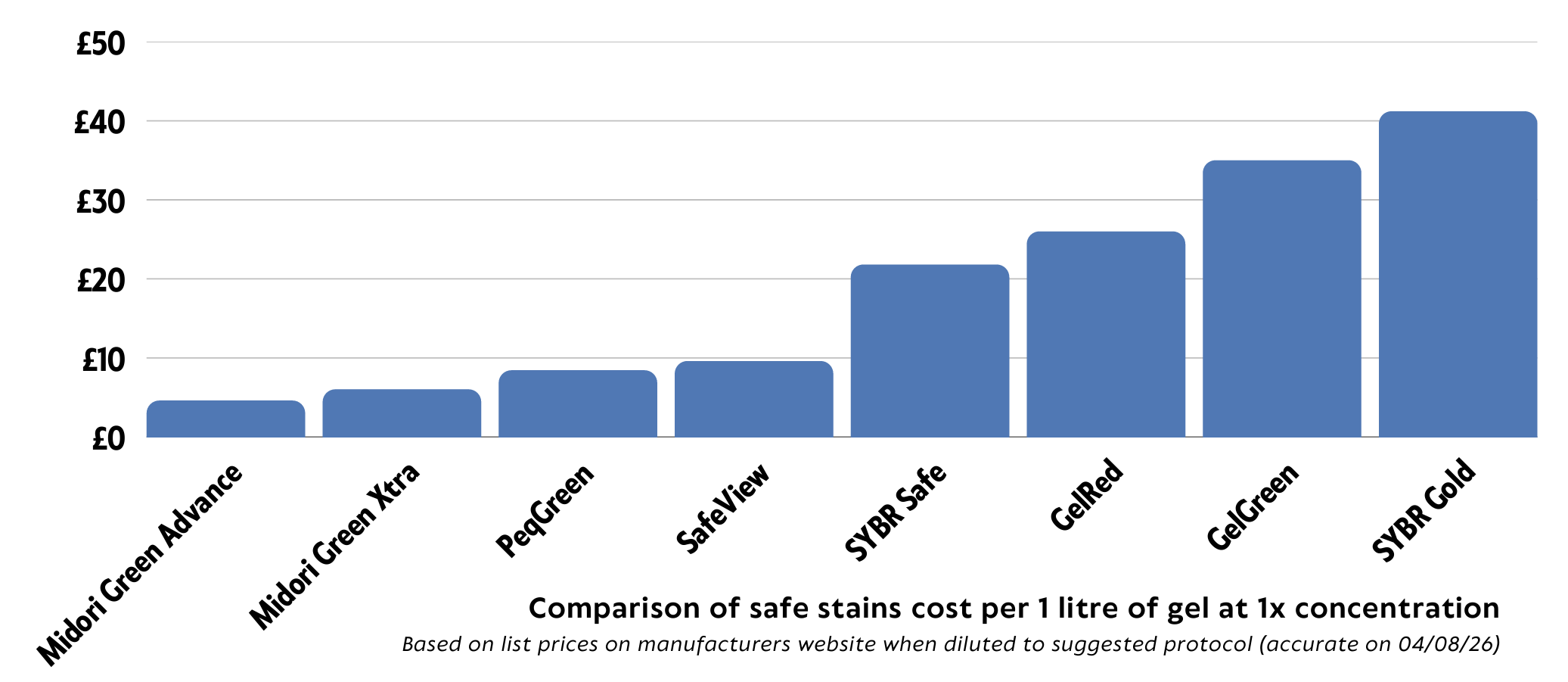
The cost of a DNA stain is more than the price per gel. Hazardous waste disposal, repeated experiments after a failed clone and the researcher time lost to both all count. The chart below shows the price per gel of the Midori Green stains against other safe DNA stains.
Imaging Equipment
Midori Green performs best alongside a compatible gel documentation system. Geneflow offers imaging setups for labs of different sizes and throughput.

FastGene® FAS-X
A stand-alone system for high-quality imaging with an integrated Blue/Green LED transilluminator. It is the entry point to a fully UV-free workflow.

FastGene® BG LED Transilluminator
A safe illuminator that excites Midori Green stains without exposing your DNA to UV. If you already have a camera or documentation hood, it can be added as a stand-alone upgrade.
Other imaging systems
Compact bench system
Small footprint and straightforward imaging for routine checks.
Higher-specification imaging
Greater sensitivity and imaging control for demanding core facilities.
Multi-application
For labs imaging fluorescence, chemiluminescence and multiplex gels alongside routine DNA work.
Midori Green Advance and Xtra both work under standard UV, so you do not have to change illumination to gain the safety benefit. If you view gels under UV or handle the transilluminator regularly, protect your eyes with Amber Safety Goggles.
Also Needed on the Bench
Midori Green is one part of the DNA electrophoresis workflow. These are the products that labs most often order alongside it.
Agarose
Molecular biology grade agarose for routine and high-resolution gels.
FastGene® Molecular Biology Grade Agarose
LE Multi-Purpose Agarose
Loading dye
Track your samples through the gel and confirm loading before you run.
Gel/PCR extraction
Clean, high-yield DNA recovery from the gel for downstream cloning.
Plasmid preparation
Take a cloned construct through to purified plasmid.
Band excision
A cleaner cut leaves less contaminating gel matrix in the extraction.
Frequently Asked Questions
Is Midori Green a direct replacement for Ethidium Bromide?
Yes. Midori Green Advance is designed as a drop-in replacement. It is used at a similar concentration, works under the UV transilluminators most labs already own and gives comparable band intensity, without the mutagenicity or hazardous waste classification of Ethidium Bromide.
Do I need to buy new equipment to switch to Midori Green?
No. Midori Green Advance performs well under standard UV illumination, so you can change stain without changing your transilluminator. For the best sensitivity, and to remove UV exposure entirely, pair Midori Green Xtra or Midori Green Direct with a Blue/Green LED transilluminator when you are next due an upgrade.
What is the difference between Midori Green Advance, Xtra and Direct?
Advance is optimised for UV illumination and is the simplest replacement for EtBr. Xtra is tuned for sensitivity on Blue/Green LED systems, with a clean background and no mobility shift. Direct is added to the sample instead of the gel, which gives the fastest workflow and the lowest gel background, and suits high-throughput screening and cloning pipelines.
Why does UV exposure affect cloning success if the gel image looks fine?
UV light at 254-310nm, as used by most transilluminators, causes pyrimidine dimers and nicks in DNA. The damage does not change how a band looks, but it reduces the efficiency of restriction digestion, ligation and transformation later in the protocol. Imaging under safe Blue/Green LED light with Midori Green removes that exposure.
How should Midori Green waste be disposed of?
Midori Green is classified as non-hazardous waste on the basis of independent safety testing, so it does not need the dedicated hazardous waste stream that Ethidium Bromide requires. Always confirm disposal against your institution’s current COSHH assessment and local waste policy.
Ready to make the switch?
Contact your Geneflow account manager about sample sizes, current pricing, and which Midori Green and gel documentation combination suits your lab.