

Safer Samples, Sharper Signals: The Superiority of Blue/Green LED Illumination
Discover how a broader spectrum of visible light eliminates DNA damage, enhances dye compatibility, and delivers publication-quality images, revolutionizing your molecular biology workflow.
In This Guide, You’ll Learn:
- Why Blue/Green LED illumination is safer for your samples and superior to traditional UV and single-wavelength Blue LED systems.
- The key advantages of a broad spectrum: total sample safety, incredible dye versatility, and exceptional signal performance.
- How to choose the right FastGene® system and MIDORI Green™ stain to optimize your specific laboratory workflow.
Estimated Read Time: 5 minutes
The Hidden Costs of Traditional Illumination
The Dangers of UV Light
For decades, UV transilluminators have been a staple in molecular biology for visualizing nucleic acids. However, their utility comes at a significant cost. Exposure to high-energy UV radiation is not only a health hazard for researchers, but it also inflicts severe damage on the samples themselves.
UV light causes thymine dimer formation and DNA strand breaks, compromising the integrity of your sample. This UV-induced damage significantly reduces the success of downstream applications like cloning and sequencing. Even a brief 30-second exposure to UV light can dramatically lower cloning efficiency, rendering precious samples unusable.
The Limitations of Blue LED
As a safer alternative to UV, standard Blue LED illuminators operating at a single, narrow wavelength (≈470 nm) were introduced. While they eliminate the risk of DNA damage, they present their own set of challenges.
This narrow spectrum leads to the inefficient excitation of many common fluorescent dyes, resulting in weaker signals, higher background noise, and suboptimal image quality. Crucially, standard Blue LED light is often incompatible with popular red DNA dyes, limiting your experimental flexibility and forcing labs to maintain multiple imaging systems.
The Blue/Green LED Revolution: A Safer, Broader Spectrum
Blue/Green (BG) LED technology represents a paradigm shift in gel documentation. By utilizing a broad excitation spectrum from 470 nm to 520 nm, it combines the safety of visible light with performance that surpasses traditional methods. This innovative approach addresses the core drawbacks of both UV and standard Blue LED systems, offering a comprehensive solution for the modern lab.
Total Safety
Operating entirely within the visible light spectrum, BG LED technology is completely safe for users and samples. It eliminates the risk of DNA degradation, ensuring maximum sample integrity for cloning, sequencing, and other sensitive applications without the need for protective gear.
Incredible Versatility
The broad spectrum effectively excites an extensive range of fluorophores. One illuminator can be used for green, yellow, and red DNA dyes, as well as fluorescent proteins like GFP, RFP, and YFP. This versatility streamlines workflows and reduces the need for multiple devices.
Exceptional Performance
The high-intensity, multi-wavelength illumination provides superior excitation, leading to brighter signals, lower background, and sharper images. This enhanced sensitivity allows for the detection of minute amounts of nucleic acid, delivering clear, publication-quality results every time.
Visualizing the Advantage
The graph below clearly illustrates the advantage of Blue/Green LED technology. While UV light effectively excites Ethidium Bromide, it does so in a damaging wavelength range. The broad peak of Blue/Green light optimally overlaps with the excitation spectrum of safe dyes like MIDORI Green™, capturing more energy for a stronger, clearer signal without harming the DNA.

A System for Every Lab: The FastGene® Blue/Green LED Family
NIPPON Genetics has engineered a comprehensive portfolio of gel documentation systems and illuminators, ensuring that every lab—regardless of budget or throughput—can access the benefits of Blue/Green LED technology.
FastGene® FAS-X: The Pinnacle of Performance
The award-winning, German-engineered FAS-X is the ultimate standalone gel doc system. It combines a powerful 20 MP scientific-grade camera with an intuitive, icon-based software on a massive 13.3″ full HD touchscreen. Its market-leading 26 x 21 cm illumination area accommodates multiple or oversized gels, streamlining high-throughput workflows.

FastGene® FAS-DIGI PRO: Power and Flexibility
For labs that prefer a PC-connected workflow, the FAS-DIGI PRO offers a high-resolution 24 MP scientific grade camera and comprehensive control software. It combines the same large Blue/Green transilluminator with a dark hood and a professional camera for ultimate control over your images.
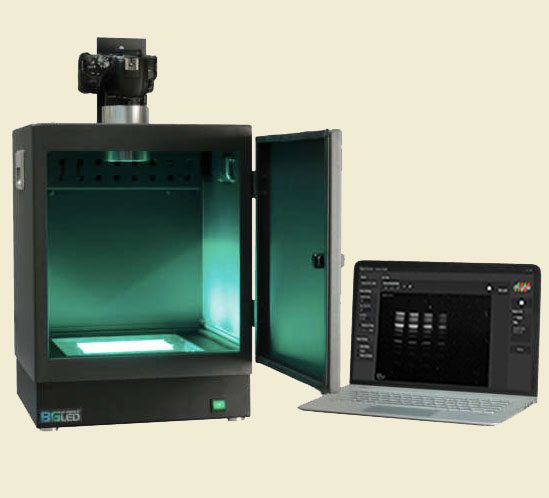
FAS-BG LED BOX: All-in-One Compact Solution
Ideal for labs with limited bench space, this compact standalone system features an integrated 8 MP camera, a large touchscreen, and the versatility of both Blue/Green and White LED trans- and epi-illumination for documenting protein gels and membranes.

Blue/Green LED XL Transilluminator
If you already have a camera setup, you can still upgrade your workflow. This standalone transilluminator provides the same large, uniform Blue/Green illumination found in our premier systems, allowing you to safely excise bands and capture images without DNA damage.

A Perfect Match: The MIDORI Green™ DNA Stain Family
To create a completely safe and optimized workflow, pair Blue/Green LED technology with MIDORI Green™ DNA stains. These non-toxic, non-mutagenic alternatives to Ethidium Bromide are specifically designed to be maximally excited by Blue/Green light. This synergy yields exceptional signal sensitivity with minimal background, ensuring you get the clearest possible results while maintaining a safe lab environment. The MIDORI Green family offers a stain for every protocol:
MIDORI Green Xtra
The ideal choice for in-gel staining. Simply add it to your molten agarose for uniform, sensitive staining throughout the gel.
Compatibility: Strongly recommended for Blue/Green LED illuminators.
MIDORI Green Advance
A highly sensitive stain for in-gel or post-staining protocols, offering flexibility for various imaging systems.
Compatibility: Works with both UV and Blue/Green, but performs best with UV light.
MIDORI Green Direct
The perfect stain for convenience. Add it directly to your DNA sample before loading, eliminating extra steps.
Compatibility: Works with UV and Blue/Green, but performs best with Blue/Green light.
Ready to Revolutionize Your Gel Documentation?
Step into the future of safe and efficient imaging. Explore our range of Blue/Green LED systems and see the difference this superior technology can make in your lab.