

Is your Western blotting substrate limiting what you can detect? The Westar range from Cyanagen offers four levels of sensitivity, from mid-picogram to attogram detection, so you can match the substrate to your target instead of making one ECL reagent do every job. This guide compares Westar against the substrates most labs already use, including Pierce ECL, Amersham ECL, SuperSignal West Dura, SuperSignal West Femto, Clarity, Clarity Max and Immobilon, using side-by-side blots.
In This Guide
- Why a single ECL substrate for every blot leads to saturated bands, missed targets and wasted reagent.
- Which Westar substrate is equivalent to Pierce ECL, Amersham ECL Prime, SuperSignal West Dura, SuperSignal West Femto, Clarity Max and Immobilon Ultra Plus.
- Customer data and head-to-head blots comparing Westar with its competitors.
- Which imaging systems get the most from a high-sensitivity substrate.
1. The Right Light for Every Experiment
Western blotting is used for two quite different jobs: quantifying abundant proteins and hunting for trace targets. Using the same substrate for both tends to end in one of two ways. Abundant targets saturate and lose their quantitative value, or low-abundance targets never appear at all.
The Westar family is built around tiers of sensitivity, so you can choose the substrate that suits the protein, the antibody and the imager you are using. The table below shows where each Westar substrate sits and which established ECL reagents it is designed to compete with.
| Feature | Westar Sun | Westar Antares | Westar Supernova | Westar Hypernova |
|---|---|---|---|---|
| Detection level | Mid picogram | Mid femtogram | Low femtogram | Attogram |
| Key strength | Entry-level substrate for routine blots | Extremely long signal duration and broad linear dynamic range | Ultra-high sensitivity with wide linear dynamic range | Extreme signal intensity for the faintest bands |
| Best suited to | Abundant proteins, routine blots | Quantitative work, multiple exposures, many blots | Low-abundance targets, precious samples, antibody savings | Minute amounts of protein, very dilute antibodies, limited lysate |
| Competitor equivalents | Pierce ECL, Amersham ECL, Amersham ECL Start, Immobilon Classico | SuperSignal West Dura, SuperSignal West Pico PLUS, Amersham ECL Prime, Clarity, Immobilon Crescendo, WesternBright Quantum | SuperSignal West Femto, Clarity Max, Amersham ECL Select, Western Lightning Ultra, Takara Western Blot Ultra Sensitive HRP, Chemi-Lumi One Ultra, WesternBright Sirius | Immobilon Ultra Plus |
2. Seeing Is Believing: Customer Data
In the comparison below, a customer tested the Westar range against a serial dilution. The results show why matching the substrate to the target matters.
 Figure 1: Sensitivity limits when detecting recombinant protein. Westar Sun reaches its limit at 1.6ng with a clean background, while Westar Supernova continues to detect bands down to 64pg.
 Figure 2: Detection of S6K1 in HEK293 lysate at different loads. Westar Sun gives a clean signal at higher loads (5µg) with low background. Westar Antares sits in the middle, and Westar Supernova reveals the most at low nanogram loads.
Key takeaway: if your target is low in abundance, moving from a standard ECL reagent to Supernova can make a missing band visible.
3. Westar vs The Rest
The blots below are manufacturer data from Cyanagen (selection guide Rev03, March 2026). In each case the same HeLa lysate dilution series, antibodies and imager were used for Westar and its competitors, so the bands can be compared directly.
Westar Sun vs Competitors
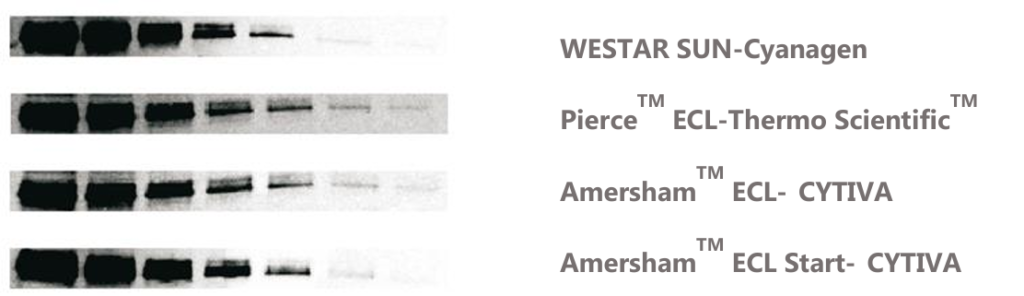 Figure 3: Western blot detection of ERK-1/2 in HeLa cell lysate with Westar Sun, Pierce ECL (Thermo Scientific), Amersham ECL (Cytiva) and Amersham ECL Start (Cytiva).
Sample: two-fold dilution of HeLa lysate from 5µg to 0.078µg. Primary antibody: rabbit anti ERK-1/2, 1:1000. Secondary antibody: donkey anti-rabbit IgG HRP, 1:5000. Imager: Westar R (Hi Tech Cyanagen). Exposure: 90 seconds.
Westar Antares vs Competitors
 Figure 4: Western blot detection of HDAC-1 in HeLa cell lysate with Westar Antares, SuperSignal West Dura (Thermo Scientific), Amersham ECL Prime (Cytiva), SuperSignal West Pico PLUS (Thermo Scientific) and Clarity (Bio-Rad).
Sample: two-fold dilution of HeLa lysate from 5µg to 0.078µg. Primary antibody: rabbit anti-human HDAC-1, 1:5000. Secondary antibody: goat anti-rabbit IgG HRP, 1:75000. Imager: ImageQuant LAS 4000 (GE Healthcare). Exposure: 180 seconds.
 Figure 5: Extended signal duration of Westar Antares compared with SuperSignal West Dura, Amersham ECL Prime, SuperSignal West Pico PLUS and Clarity. Blots were imaged at 0, 2, 5, 8, 11 and 20 hours, with a 180 second exposure at every time point.
Antares still gives a readable signal at 20 hours, which is what makes it a good choice for multiple exposures and large batches of blots.
Westar Supernova vs Competitors
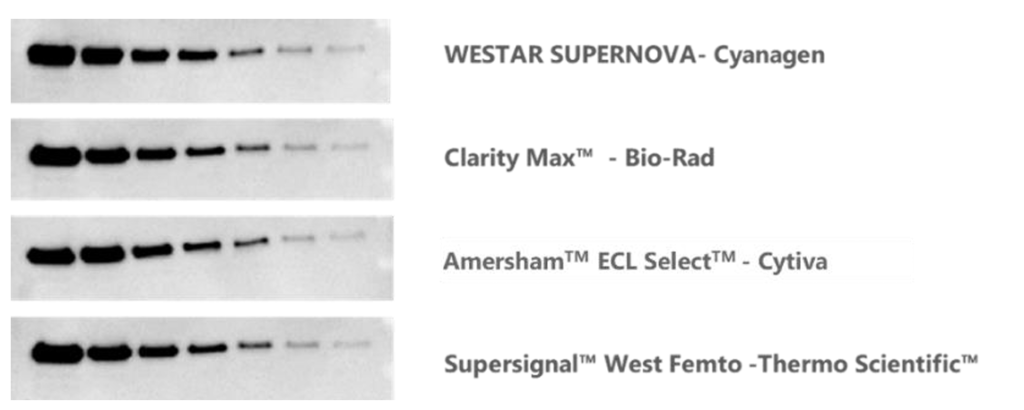 Figure 6: Western blot detection of HDAC-1 in HeLa cell lysate with Westar Supernova, Clarity Max (Bio-Rad), Amersham ECL Select (Cytiva) and SuperSignal West Femto (Thermo Scientific).
Sample: two-fold dilution of HeLa lysate from 2.5µg to 0.039µg. Primary antibody: rabbit anti-human HDAC-1, 1:10000. Secondary antibody: goat anti-rabbit IgG HRP, 1:300000. Imager: ImageQuant LAS 4000 (GE Healthcare). Exposure: 120 seconds.
4. Find Your Perfect Match
Westar Sun: The Everyday Workhorse
Cyanagen’s entry-level substrate, suited to routine blots where the target protein is abundant. If you currently use Pierce ECL or Amersham ECL, Westar Sun is the like-for-like comparison.

Westar Antares: The Long-Distance Runner
A versatile substrate that needs less optimisation, with an extremely long signal duration. That makes it a good fit when you need several exposures or have a stack of blots to image. Its broad linear dynamic range allows low and high abundance proteins to be quantified in the same experiment.

Westar Supernova: The Deep Space Telescope
For precious samples and low-abundance proteins. Supernova detects very low amounts of protein using less antibody, and its wide linear dynamic range suits quantitative analysis as well as detection.

Westar Hypernova: Attogram Detection
The most sensitive substrate in the range, developed by Cyanagen for the faintest bands. It suits minute amounts of protein, extremely dilute antibodies or limited lysate, and gives bright bands in a few seconds of exposure.
5. Complete Your Detection Workflow
A high-sensitivity substrate needs an imager that can capture what it produces. Film has a limited dynamic range (around 1.5 orders of magnitude), which leads to saturation. To make full use of Westar Antares, Supernova and Hypernova, pair them with a cooled CCD imager offering a dynamic range of 3 to 5 orders of magnitude.

Syngene G:BOX Chemi XRQ
- Cooled CCD technology: a high quantum efficiency sensor reduces background noise, which helps with the faint bands revealed by Westar Supernova.
- Wide dynamic range: capture intense and weak signals on the same blot without saturation, which suits the extended signal from Westar Antares.
- GeneSys automation: protocol-driven software selects filters and lighting for publication-quality images.

Syngene G:BOX mini XRQ
- Compact footprint: a sensitive 4MP cooled 16-bit CCD camera and an f1.2 lens in a space-saving unit.
- Versatile: suited to multi-user labs, covering chemiluminescence, stain-free gels and multiplex fluorescence.
- GeneSys Autocapture: automated capture for high-resolution, quantifiable results.
Ready to Upgrade Your Westerns?
Choose the Westar substrate that matches your target and your imager.
Buy Westar Sun Buy Westar Antares Buy Westar Supernova Buy Westar Hypernova
Competitor comparisons are based on data supplied by Cyanagen (Westar selection guide, Rev03, 9 March 2026). Pierce, SuperSignal and Thermo Scientific are trademarks of Thermo Fisher Scientific. Amersham and Cytiva are trademarks of Cytiva. Clarity and Clarity Max are trademarks of Bio-Rad. Immobilon is a trademark of Merck KGaA. Western Lightning is a trademark of Revvity. WesternBright is a trademark of Advansta. All other trademarks belong to their respective owners, and Geneflow is not affiliated with them.